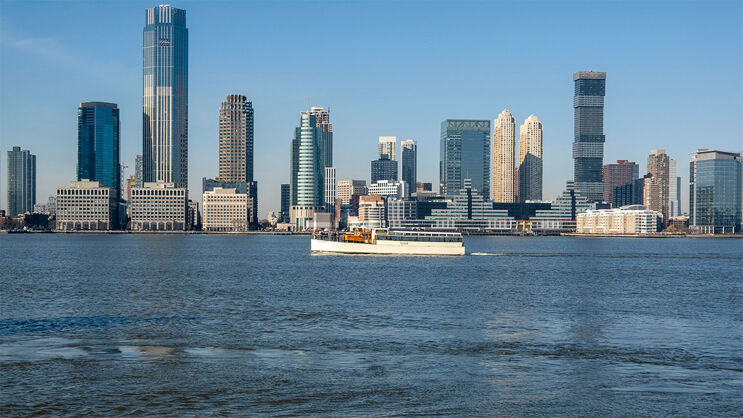
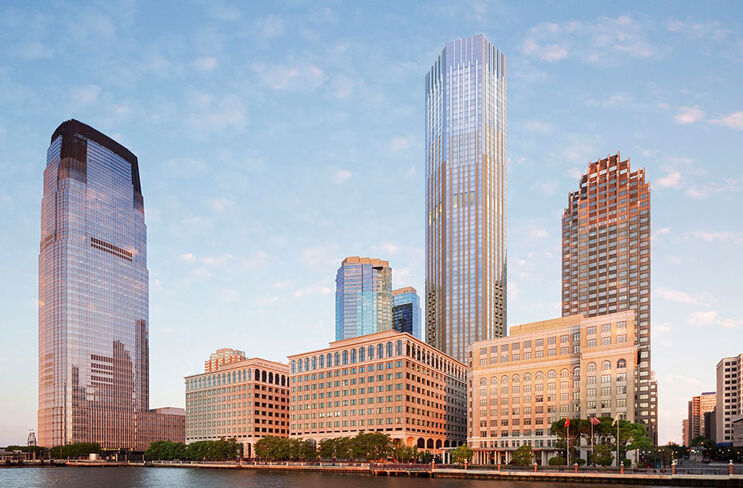
For the city of Jersey City, the construction of the 99 Hudson skyscraper means above all one thing: another step out of New York's shadow. New buildings like this not only offer more space and exclusive living space for commuters – the goal of the responsible architectural firm Perkins Eastman was also to elevate the entire cityscape to a new level through the presence of the high-rise.
Over 20,000 natural stone slabs made of Bavarian Jura limestone – also called Jura marble – adorn the building envelope of the 79-story skyscraper, which is held by around 110,000 fischer FZP II undercut anchors. Through close collaborative partnership with the internationally involved companies, fischer was able to deliver a customized special solution for the high demands of the large-scale project. Constantin Wiegert, head of façade and fire protection systems at fischer SystemTec, supervised the construction project, which started in 2016, together with other fischer experts until its completion.
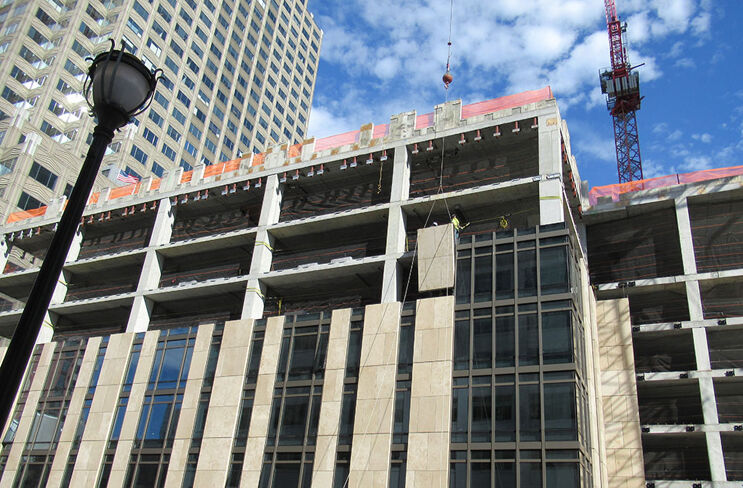
Construction projects in inner cities often pose a challenge due to limited space availability. „Among other reasons, the decision was made for an element facade, which allowed us to achieve an enormously high degree of prefabrication. This is very well possible with our systems“, explains Wiegert. Since the fastening solution is a complete system, the individual components and work steps were distributed across different locations. „The special drilling machines and drill bits were delivered to the natural stone supplier Jura Marble Suppliers in Bavaria, where the panels were directly equipped with the undercut holes. The anchors went through our importer PROBE Rainscreen Facade Systems to the facade builder Gamma in Miami. There, the components were assembled in the factory and delivered ready for installation to the construction site.“ This enabled the highest efficiency both logistically and economically, which also saved operating costs and time on the construction site locally.
No construction project is immune to unforeseen events or changing conditions. In the case of 99 Hudson, new simulations of wind loads required a quick response and adjustment of the fastening solution. "In many areas, the wind loads were higher than initially assumed," recalls Constantin Wiegert. Up to 5000 Newtons act per square meter on the building envelope. "For the natural stone panels used, this corresponds per panel to roughly the weight of a mid-size car. For our anchors, such forces are not a problem, but the stone eventually yields and breaks conically around the anchor." A rapid solution was a top priority. New calculations and testing finally led to the goal: a double fastening. "Thanks to the expansion-pressure-free FZP II anchors, it was possible to set two drill holes five centimeters apart, so that tensile, compressive, and self-weight forces can be safely transferred without causing additional stresses in the material."
With the company's own test field at the Tumlingen Research and Development Center, fischer has the ability to conduct tests for any project very quickly and in compliance with the prescribed test procedures. This applies not only to applications in the European context. The fischer test field is also equipped for testing according to international standards. “For 99 Hudson, the parameters were defined by the ASTM International Standard, C1354. It differs, for example, in that the stones must be stored in water for several days before testing. And the methodology is also different,” explains Constantin Wiegert. “Thanks to the flexibility and solution-oriented approach of our test laboratory, it was no problem to replicate the American standards with our machines and testing equipment. A major advantage is that we can respond very economically and quickly to conditions.”
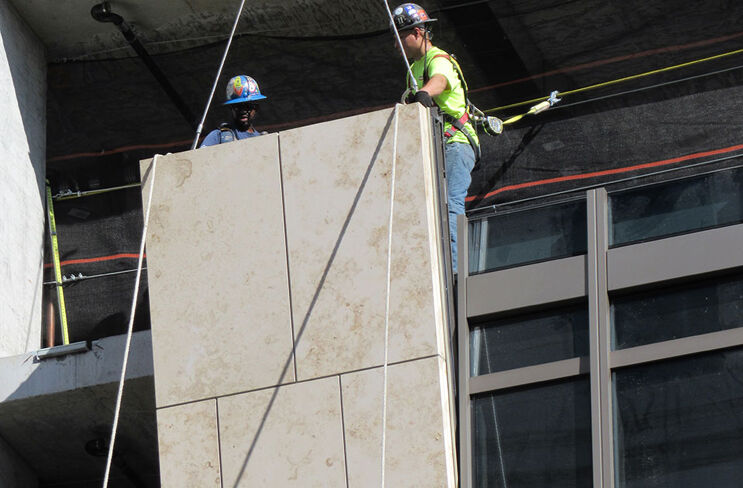
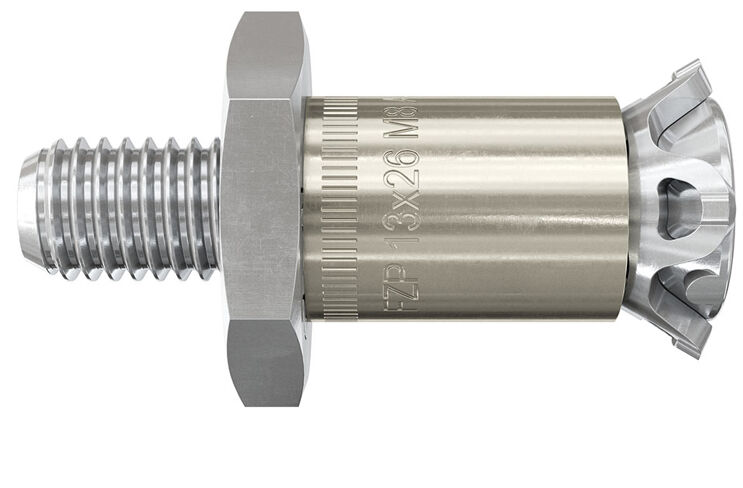
Around 110,000 fischer Zykon plate anchors of the type 13x30 M8/SO/13 AL secure the Jura limestone facade of the tallest skyscraper in Jersey City. The anchors provide a form-fit and therefore completely expansion-pressure-free fixing, which is not visible even in the joint pattern from the building's facade side. Unlike edge fastenings, the undercut technology enables the realization of an element facade and factory prefabrication. The result is a permanently securely fixed, representative building facade.
The compensating undercut anchor made of stainless steel for natural stone
The invisible spacer mounting solution for heavy natural stone facade panels. The fixing point is not visible from the outside and ensures an optically appealing and continuous facade surface. The spacer mounting automatically compensates for panel thickness tolerances – this makes the fischer undercut anchor unique. The matched shape of the undercut anchor ensures a form-fitting and thus expansion-stress-free fixing in the conically undercut drilled hole.
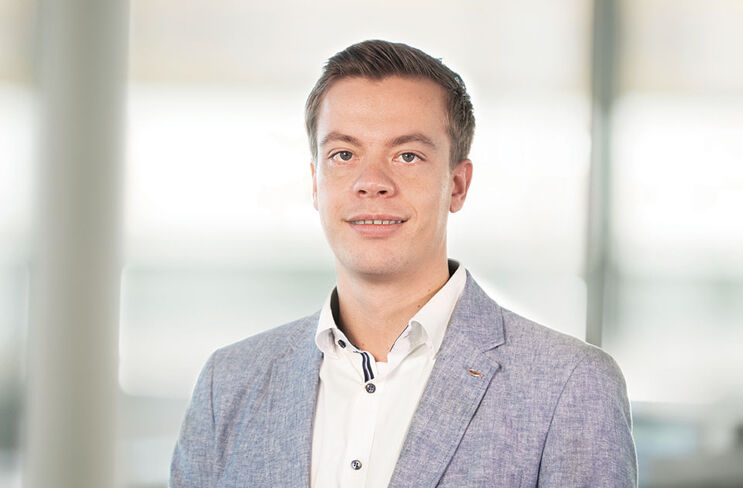
„As a dual student in civil engineering, I joined the fischer Group in 2012. After my studies, I started my first position as an application engineer in 2015, where I advised and supported fischer customers on a wide range of application issues. During this time, my interest in the United States and the market there developed. Since we are now very active there and, among other things, carry out projects in all districts of New York, the opportunity arose in 2016 to take responsibility for the 99 Hudson Street project. I am very pleased that fischer is also considered a reliable partner for major projects in facade construction in the USA. There, as in Europe, we work to not only excite our customers but to exceed their expectations.“