Secure hold at the edge: When everything depends on one anchor

Cave explorers trust fischer

Secure hold at the edge: When everything depends on one anchor
"Twelve people have already been on the moon," says cave researcher Axel Hack. "But on our planet, there are still places that no one has ever set foot on." What lies beneath the Earth's surface in caves cannot be measured or observed by satellites. Axel Hack and his colleagues repeatedly venture into this unknown terrain and bring to light what lies hidden here. A field of research also known as speleology. "We explore caves to learn more about our Earth so that we can protect it better," Axel Hack explains the endeavor.
Image: Axel Hack

Property Brief

Object Type
Cave
Total length
113 km
Depth
With 1,560 m height difference ranked 9th worldwide
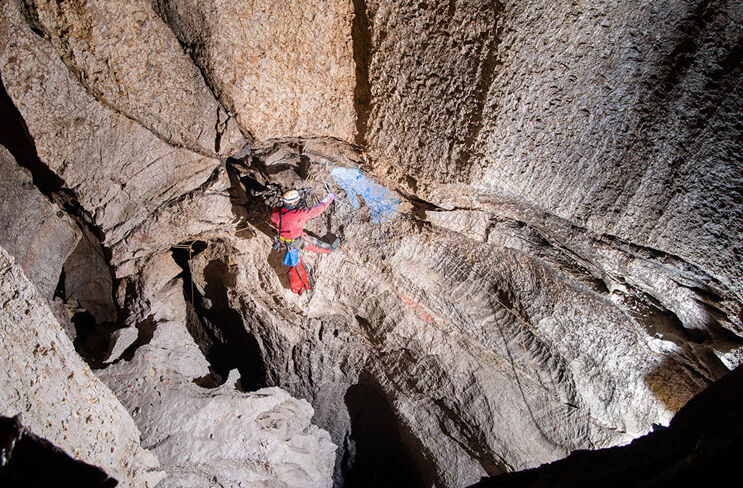
Since 2012, he has been a member of the Dachstein Caving Expedition, which has been studying and mapping the caves on the plateau of the Dachstein Mountains in Upper Austria for over 40 years. "Over 850 meters underground, far from help, we make our way through the tightest passages and deep shafts," Axel Hack describes the Dachstein expeditions. "We battle cold, hard rock, flash floods, and liquid clay." Numerous verticals are interspersed with former river loops that have deeply carved into the rock, Axel Hack continues. Crossing these so-called meanders requires a lot of energy. Not to mention the many steep walls that the cave explorers have to climb again and again.
Image: Axel Hack

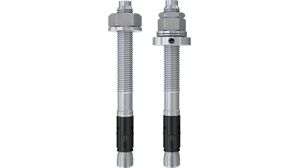
“Especially here, where it goes so vertically and slippery down or up, the cave ropes have to be securely anchored,” says Axel Hack. “We rely on fischer steel anchors in this regard. I feel safer when I’m hanging on the attachments of a German quality manufacturer.” Therefore, thousands of fischer bolt anchors such as the FBN II and the FAZ with eight-millimeter diameter have already been installed in the caves for rope anchoring on the expeditions. The majority of these were used in the Wot U Got Pot (WUG) shaft system.

At the beginning of September 2018, the breakthrough occurred: After over ten years of research in the WUG, the researchers discovered a new connecting passage from the WUG to the Hirlatzhöhle. This increased the explored total length of the underground labyrinth by 7.2 kilometers to over 113 kilometers. Thus, the Hirlatzhöhle is now the 20th longest cave in the world. In depth, it ranks 9th with a height difference of 1,560 meters.  


Image: Axel Hack
Since then, the research team has been hoping to connect more higher-altitude caves. It is expected that the system will grow vertically by up to 90 meters. This propelled the Hirlatzhöhle to 6th place worldwide in depth and 2nd place in Europe. Additionally, further shaft caves are to be explored. From August 17 to September 5, cave explorers from all over Europe once again descended into the chasm of the alpine large cave. The meeting point was the Dachstein plateau on the Hallstätter side. "Safe equipment is of utmost priority in such expeditions," says Axel Hack. "This time as well, we could assess what awaited us: temperatures around two degrees, high humidity, frequent water ingress in the vertical sections, and heavy mud deposits in the passages." In some areas, walls where anchors are to be placed are coated with mud several centimeters thick, Axel Hack adds. "And the Dachstein limestone is hard and thick-banded. In some cases, it is also cracked or corroded."
Image: Axel Hack
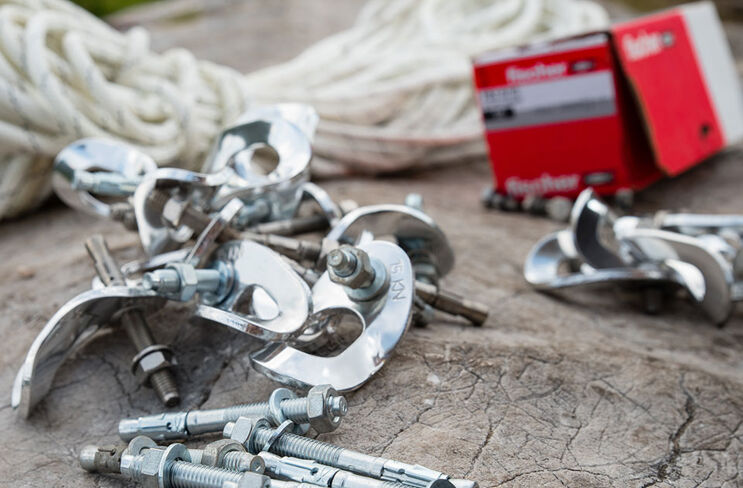
The cavers brought plenty of ropes, bolt anchors, cordless rotary hammers, as well as freeze-dried meals and equipment for the camp into the underground world, transported in sanding bags made from truck tarpaulins. Also included in the gear: 300 fischer bolt anchors FBZ 8/10 made of stainless steel (A4) as well as electro-galvanized steel. The fastenings provide secure hold in the stubborn limestone rock. Bent M8 tabs, made from aluminum or stainless steel Inox 304/316, are anchored to the rock. Ropes can be hung onto them using screw links.
Image: Axel Hack
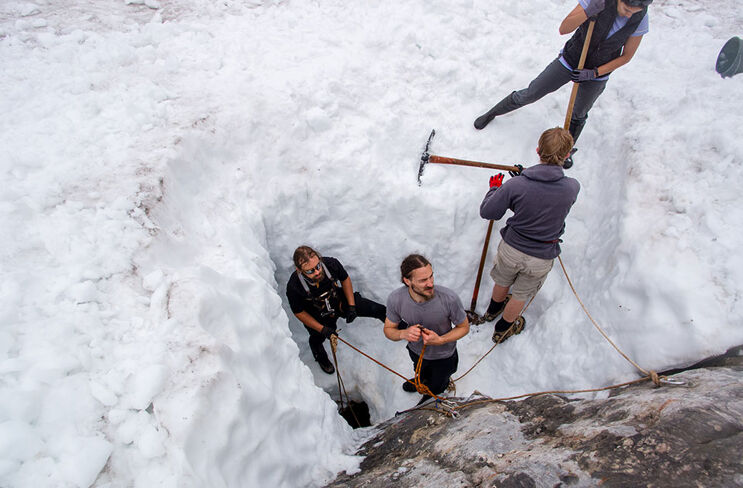
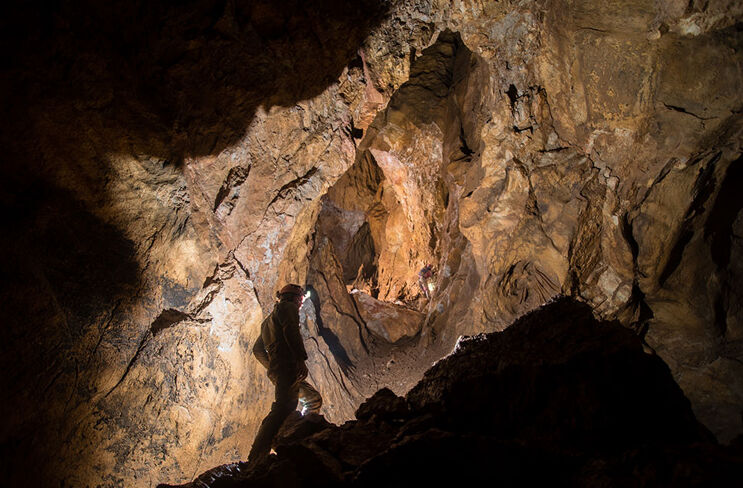
Initially, the weather prevented any progress: “WUG, our gateway to the Hirlatzhöhle, was buried under seven meters of snow. But where there’s a will, there’s a way – and we successfully dug our way through,” reports Axel Hack. “Then it rained for days, and the caves were heavily flooded.” Eventually, the underground gorges and passages could be explored further. This allowed the team to continue researching the Thundergasm Cave, which they discovered in 2017. Last year, the researchers mapped it at a depth of about 200 meters but were halted by an unknown meander. Now the team has learned more. “We never know what to expect: In this case, it went from a deep and slippery canyon into a wide passage and then into an area with cascading water and rusty red, crumbly, sharp stone. On the ground, a deep and raging meander twisted,” Axel Hack describes this unknown mountain world.
Image: Axel Hack
The cave explorers also learned a lot of new things about the WUG. "Coming from vertical shafts and canyons, we entered huge fossil tubes." Sticky mud constantly spread over the equipment and made the boots twice as heavy as usual. From the Chutney Mine, it went into another passage which was explored and measured: a very muddy dead end with a collapse at the end. The Left Fork section and the so-called Time Bandit were also further explored.
We explore caves to learn more about our Earth so that we can protect it better.
Axel Hack, member of the Dachstein Caving Expedition

In addition, further research was conducted at the end of the Uphill Gardens. Here, Axel Hack and his team drilled 25 meters up a steep clay ramp. In some places, the rock had to be cleared of ten centimeters of deep and damp clay in order to set the rock anchors. The team worked under these adverse conditions for four hours. After around 30 rock anchors had been set, it was accomplished: The researchers stood in the spacious, still unexplored Passage No. 33. “I have never seen a more beautiful passage in the WUG. It is richly decorated with stalagmites and other formations,” raves Axel Hack. “After a good 100 meters, we unfortunately had to turn back. Although the passage continues much further into the mountain, time was running out. We also had to return to the ropes to then climb 650 meters up.” After a total of 18 hours, the team reached the surface again, tired but safe.
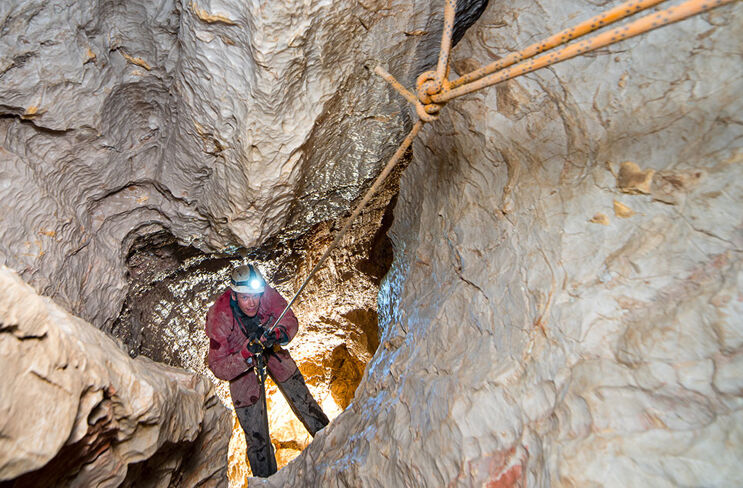
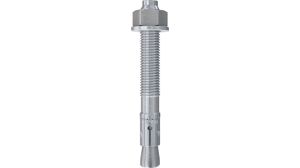
Image: Axel Hack
Although no further connection between higher caves could be discovered yet, the researchers bring plenty of new knowledge about the mountain world and its winding paths to the surface, which brings them much closer to their goal. "The Fischer bolt anchors we used remained stable throughout the expedition, even in surprisingly poor rock," Axel Hack is relieved.
cd-green-55965cdb4b-d4shb